Discovering Westcave: The Natural & Human History of a Hill Country Nature Preserve by S. Christopher Caran & Elaine Davenport
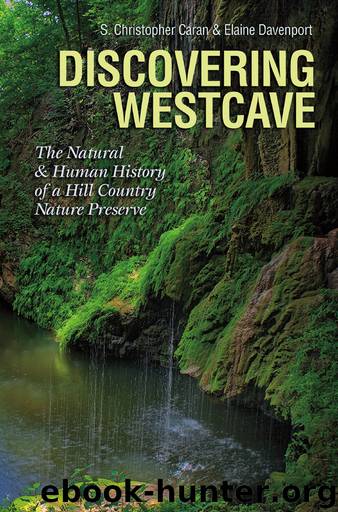
Author:S. Christopher Caran & Elaine Davenport [Caran, S. Christopher]
Language: eng
Format: epub
Publisher: Texas A&M University Press
Published: 2016-03-21T16:00:00+00:00
Noteworthy late Paleoindian projectile point circa 10,000 years before present found in the Westcave area. One third to one half of the artifact, including the tip, is missing. Note the fine parallel-flaked workmanship. Photo by Erich Rose
Just south of the preserve an Early Archaic burned-rock midden was located and briefly investigated in 1977. Burned-rock middens are rock mounds where plant roots and other food items were baked. This site yielded Bulverde dart points, which date from 3000 to 1500 BC. Also found were some partially worked pieces, flint cores, and waste products from point and other tool manufacture.
A long history of uncontrolled relic hunting prior to establishment of the preserve may have damaged some sites, but there are no known sites of importance in the area. Today, the preserve prohibits excavation or disturbance of any object of antiquity.
Prehistoric Era
Considering the area’s high value as a place to live, lying as it does in an area of remarkable biodiversity, it is little wonder that the history of human occupation here spans many thousands of years. Archeological investigations have provided a general understanding of the lifestyles of these prehistoric inhabitants of central Texas. Most of the evidence is based on interpretation of artifacts. Over thousands of years, toolmaking, acquiring and processing plant and animal resources, and other endeavors produced tangible byproducts—artifacts and other remains—that have survived to the present.
The time of the earliest habitation of this region is the subject of ongoing investigations, but we can state with some assurance that there are records of human presence in central Texas from at least fourteen thousand years ago. In this region the prehistoric era began with the first appearance of humans and continued until Europeans first explored Texas, about AD 1500. The earliest humans in central Texas probably formed small nomadic bands operating over very large territories. These groups may have hunted large herd animals almost exclusively, but the growing population became increasingly reliant on a variety of animal resources, including deer, land tortoises, aquatic turtles, alligators, and raccoons. Spring-fed streams in the Hill Country/Balcones Canyonlands region provided rich habitats and ready sources of water.
The prehistoric cultural era can be divided into four broad periods: Pre-Clovis, Paleoindian, Archaic, and Late Prehistoric. Because there is scant record of Pre-Clovis or Paleoindian habitation of the immediate area, the discussion of human prehistory here begins with the Archaic Period.
Archaic Period
The Archaic Period, from about 6000 BC to AD 800, is usually separated into three stages, Early (6000–2500 BC), Middle (2500–400 BC) and Late (400 BC to AD 800). A shift in technology is evident during the transition to the Archaic, with a change from lance-shaped projectile points to stemmed dart points. Artifacts recovered from Archaic sites include a variety of dart points used for hunting and tools such as manos and metates used to grind food items.
The atlatl appeared during the Archaic period. This device, a weighted shaft, was used to throw the short spears or darts for which the dart points were made. Dart points
Download
This site does not store any files on its server. We only index and link to content provided by other sites. Please contact the content providers to delete copyright contents if any and email us, we'll remove relevant links or contents immediately.
The Brazilian Economy since the Great Financial Crisis of 20072008 by Philip Arestis Carolina Troncoso Baltar & Daniela Magalhães Prates(327420)
International Integration of the Brazilian Economy by Elias C. Grivoyannis(111451)
The Art of Coaching by Elena Aguilar(53470)
Flexible Working by Dale Gemma;(23329)
How to Stop Living Paycheck to Paycheck by Avery Breyer(19793)
Thinking, Fast and Slow by Kahneman Daniel(12452)
The Acquirer's Multiple: How the Billionaire Contrarians of Deep Value Beat the Market by Tobias Carlisle(12395)
The Radium Girls by Kate Moore(12112)
The Art of Thinking Clearly by Rolf Dobelli(10637)
Hit Refresh by Satya Nadella(9212)
The Compound Effect by Darren Hardy(9090)
Tools of Titans by Timothy Ferriss(8519)
Atomic Habits: Tiny Changes, Remarkable Results by James Clear(8448)
Turbulence by E. J. Noyes(8143)
A Court of Wings and Ruin by Sarah J. Maas(7989)
Change Your Questions, Change Your Life by Marilee Adams(7873)
Nudge - Improving Decisions about Health, Wealth, and Happiness by Thaler Sunstein(7773)
How to Be a Bawse: A Guide to Conquering Life by Lilly Singh(7562)
Win Bigly by Scott Adams(7284)
